
In modern medical education, assessment must do more than test knowledge – it must measure clinical competence. That’s where simulation plays a crucial role. From OSCE and OSPE to peer-to-peer assessments and self-directed learning, simulation offers a reliable, standardized way to evaluate practical skills in authentic, controlled settings.
With the SIMStation Exam Module, academic institutions gain a powerful tool for implementing structured, scalable assessment formats. The system flexibly adapts to your exam models, room capacities, and student numbers.
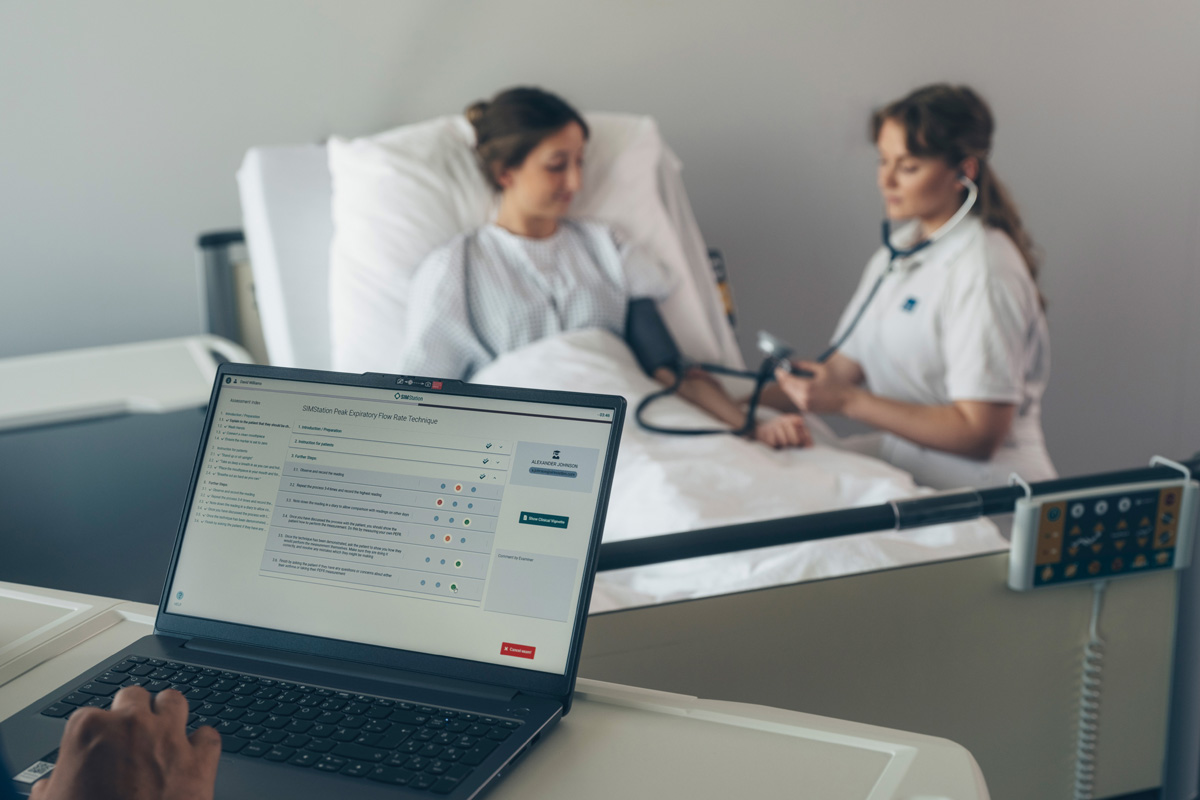
Assess clinical competencies in a standardized and transparent way. Simulation enables fair and comparable examination conditions for all participants.

Organize assessments and OSCEs efficiently and clearly. SIMStation supports the planning, automated execution, and documentation of complex examination formats.

Optionally record examinations and use structured video analysis. This allows performance to be assessed retrospectively and improved in a targeted way.
Built for the complexity of academic testing, the SIMStation Exam Module combines premium AV technology with intuitive software. The solution brings clarity and structure to your assessments – and supports learner growth through observation, reflection, and feedback.
An Objective Structured Clinical Examination (OSCE) is a practical assessment used to evaluate clinical skills and competencies in a standardized setting. Candidates rotate through a series of stations where they complete defined clinical tasks, interact with standardized patients, or respond to specific scenarios within a set amount of time.
Examiners assess performance using predefined criteria such as checklists or rating scales. This structured approach helps educational institutions evaluate clinical skills, communication, decision-making, and other competencies consistently across candidates.
Technology can support OSCEs by connecting exam planning, candidate management, station workflows, assessment, recording, and documentation within a structured digital process. This reduces manual administrative tasks and helps educators coordinate complex examinations more efficiently.
Digital solutions can also provide examiners with standardized assessment forms, support centralized monitoring, and make results and recordings available for later review.
Multi-room OSCEs require precise coordination of candidates, examiners, stations, timing, and room assignments. Digital exam management systems can help organize these elements centrally and provide a clear overview of the examination as it progresses.
Integrated room technology can additionally allow staff to monitor multiple examination rooms from a central location, helping them keep track of ongoing sessions without having to be physically present in every room.
OSCE stations can be recorded using synchronized video and audio, creating an objective record of each candidate’s performance. Depending on the setup, multiple camera perspectives and additional data sources can be captured for a more complete view of the examination.
Recordings can then be linked to the corresponding candidate and exam session, allowing authorized educators to review specific performances later for assessment, quality assurance, or feedback.
Examiners typically assess candidates using standardized checklists, rating scales, or competency-based criteria defined for each OSCE station. Digital assessment tools allow these evaluations to be completed directly during the examination and assigned to the relevant candidate and station.
Centralizing assessment data can reduce manual documentation, support consistent evaluation processes, and make results easier to review and analyze after the examination.
Universities can streamline OSCEs by managing candidates, examiners, stations, schedules, assessments, and recordings within an integrated workflow. Centralized exam management reduces the need to coordinate information across separate spreadsheets, paper forms, and systems.
Automation can further support recurring organizational tasks, while digital assessment and documentation help simplify the process from exam preparation through execution to final review.
When setting up an OSCE, institutions should consider the number of candidates and stations, room availability, examination timing, examiner assignments, assessment criteria, candidate identification, and how results will be documented and reviewed.
For larger or recurring OSCEs, it is also important to consider how technology can support centralized coordination, digital assessment, audiovisual recording, data management, and reliable workflows across multiple examination rooms.

Discover how a customized OSCE digitizes exams, reduces administrative workload, and makes education even more efficient.